Jeremy is the Youth & Family Ministry at the Johnson Church of Christ in Johnson, AR and has been in Youth Ministry for over 15 years. He graduated from Harding University in 2002 with a B.A. in Youth & Family Ministry and a minor in Art. He returned to school in 2016 to earn a Masters in Teaching.
Well if you have been paying attention this week something huge has happened in the life of your teens. Spotify Wrapped. If you have no idea what that means, it is a report from Spotify giving you your top most listened to 5 artist and songs and some other data. (Apple Music does something similar) It is pretty interesting look at our listening habits. Why do I bring that up? Because music is a strong influence that effects our faith. But if we are honest with ourselves we like what we like and don’t want to be told by anyone what to listen too. Especially teens.
Have you ever wondered what they are listening too with their headphones on? Spotify wrapped is a great window into what your teen spends a great deal of time doing. Does it matter what your teen or what any of us listen to? Does music effect our faith?
I have found two schools of thought in teens when it comes to music.
It doesn’t matter what I listen to. Regardless of the explicit language or the content of the song it doesn’t effect my faith.
It absolutely matters what I listen to and music absolutely effects my faith.
I would say teens are pretty split on these two views but perhaps more embrace the first view. Even when they know the music they listen to may be something they shouldn’t they believe it is something they can handle. What does the Bible say about? Does God care what we listen too? Here are just a few.
Do not be deceived: “Bad company corrupts good morals. 1 Cor. 15:33
Get rid of all moral filth and every expression of evil, and humbly accept the word planted in you, which can save your souls.” James 1:21
Music keeps us all company. We spend a great deal of time listening to it. I spent 45,363 minutes listening to it last year. (More than 90% of people in the US) And unlike anything else we play it on repeat until we memorize it. And then it stays with us for decades. That alone should make us cautious of what kind of company we keep. If our teens had a friend who constantly cursed and encouraged them to be sexually active or celebrate things God calls evil, how long would we allow them to spend in their company? Especially when God warns that bad company corrupts good morals. You have spent your whole life instilling good morals in them. It is worth the effort to help them see the difference between good and bad company. It is a fight worth having. You are the most influential person in their life.
God’s second piece of advice is to get rid of all “moral filth & every expression of evil”. Remove it from your life. So many in scripture have been given similar warnings by God and ignored them thinking they could handle it and what God called moral filth they called entertainment. If there is someone or something the mainly Godless culture around us widely accepts that should pause to examine if we should too.
Here is my advice when it comes to music.
Find out what they listen too. It may be a kind of music you don’t like. That is ok. Look up and read the lyrics of the songs. Read it together with them. If they are embarrassed to have you read the lyrics of the songs out loud then that is a good indication that is a song they should not continue to listen too. Block it on their listening app.
Keep up with what their favorite artist are doing. May times your teen will promote this on their social media. Do they have a new album coming out? Look up the lyrics and read them together before listening to them and becoming attached to the music. It is easier to give up something you have never heard than a song you love how it sounds. Artist change over time. Some you were ok with and approved have now moved to putting out very different and explicit music.
Talk to them about the importance of holiness, which means purity, and how music can erode our purity. Ultimately, they need to learn to make their own decisions about the company they keep. Including music. Teach them walking through the process together. Show them how to find better, even Godly music influences. There are SO many good ones out there in ever area of music. We don’t have to settle at all. They need to understand the why.
Take advantage of the time you spend together to promote good music choices. Many teens adopt the music their parents listen too. My teens Spotify wrapped summary looks a lot like mine because I have spent time influencing her songs choices whether she admits it or not. I see her pull her phone out and add a song we are listening to her playlist to go back and listen to later. Introduce them to good bands and talk about the words of songs together.
Stay involved in all the things they spend a great deal of time with. Our time with them is short but what we instill in them last a lifetime.
What do you do repeatedly on purpose? Those things are our habits.
What spiritual habits do you have?
Is it your habit to encourage your teammates or coworkers more than others spiritually around you?
Is it your habit to gossip about others instead of pray for them?
What are you in the habit of missing?
Is it your habit to miss sports or church?
Which one is harder for you to miss?
“Do not give up meeting together as some are in the habit of doing.” Hebrews 10:25
Why does God talk about meeting together needing to be a habit?
Because habits are life changing. They are direction setting. Fiber making.
What we are in the habit of doing displays our values. Are these habits holy?
Holiness should be a habit.
Holy means pure not perfect.
What continual habits have the ability to keep us holy? What habits drag us away from staying holy? God is holy. He makes us holy so we can be in His presence. Our habits have a lot to do with whether or we stay in the presence of God.
God says there is something about coming together in worship, study, fellowship, prayer, and encouragement that can not be replicated anywhere else we may look that He wants it to be a habit. It is what we do because of who we are.
Now you must give yourselves to be slaves to righteous living so that you will become holy. Do those things that lead to holiness and result in eternal life. Romans 6:22
I pray that you will take the steps needed to make holiness a habit in your life and in the life of your families.
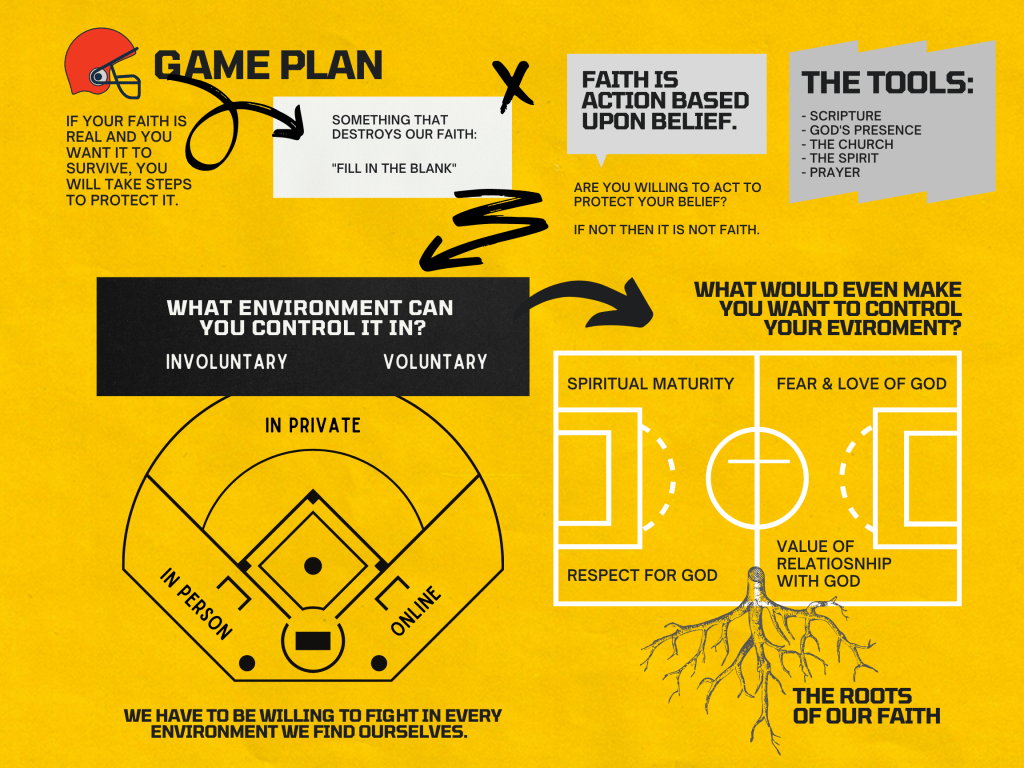
We have just finished a study we have been involved in since the end of school called “Faith in the Jungle”. How do we make sure our faith survives in the environments we are in? We will never answer this question if we are not living with spiritual eyes. How do we see our faith? How do we see the environments we are in? We will never take the time to see the tools God has given us in our faith as resources if we do not believe these two things.
Faith is important to us & worth protecting.
The environment we are in can harmful to our faith.
What do you miss when you look at your environment? If survival is on your mind, you probably are looking for all the things you can’t see. If survival of your faith is on your mind, you have to start seeing the unseen. What is seen is temporary, what is unseen is eternal.
1 Peter 5:8 Be sober-minded; be watchful. Your adversary the devil prowls around like a roaring lion, seeking someone to devour.
What if I told you there was a spider on the loose in your room. Or a snake. Would that change how you behaved? Would it change how cautious you are? If you saw a roaring lion, of course we would be cautious. But since we don’t see him working through our culture, our music, our friends even, we let our guard down and our faith is devoured.
If faith is not important to us, we will not take any measures to protect it. There will be no struggle within us between the flesh and the spirit if the flesh is the only one we are listening to. But if we believe these things, then we will use the tools that God has given us to protect our faith in the environment we live in. Jesus is at the core of our faith and faith is at the core of our identity. It is a believe based on action.
Faith is not lived in a bubble, but in a real environment.
Once we have added Jesus to our life, why do we let so many things separate us from Him?
The actions that move us away from sin and closer to God, because our belief that sin destroys our relationship with God.
1 John 1:5 This is the message we have heard from him and proclaim to you, that God is light, and in him is no darkness at all. 6 If we say we have fellowship with him while we walk in darkness, we lie and do not practice the truth. 7 But if we walk in the light, as he is in the light, we have fellowship with one another, and the blood of Jesus his Son cleanses us from all sin.
The actions to choose our environments, to play defense because we want to protect our relationship with God. We spent many weeks looking at each tool and direction God provides to us in the jungle.
We are not left defenseless. Our faith has a point. What is the outcome of your faith? Why do we fight to protect it? Use all the tools God has given you to protect it. We need a game plan.
1 Peter 1:3-9 Blessed be the God and Father of our Lord Jesus Christ! According to his great mercy, he has caused us to be born again to a living hope through the resurrection of Jesus Christ from the dead, to an inheritance that is imperishable, undefiled, and unfading, kept in heaven for you, who by God’s power are being guarded through faith for a salvation ready to be revealed in the last time. In this you rejoice, though now for a little while, if necessary, you have been grieved by various trials, so that the tested genuineness of your faith—more precious than gold that perishes though it is tested by fire—may be found to result in praise and glory and honor at the revelation of Jesus Christ. Though you have not seen him, you love him. Though you do not now see him, you believe in him and rejoice with joy that is inexpressible and filled with glory, obtaining the outcome of your faith,the salvation of your souls.
Deep into 2020, we had one teen class that was unlike the rest. It was a rough year. I had been teaching on zoom, and through YouTube for months. At best, we had class 6ft apart with masks and I wasn’t sure if anything had gotten through to them in a while. I was worried that they had lost the desire to remain close to God. I didn’t know how their faith was really doing. I gave them all a post-it note and read them a made up scenario of a teen in the church. I simply wanted them to listen and at the end write “yes or no” if that described them or not. Here is the scenario I read to them.
Micheal grew up in the church and was baptized at the age of 9 years old. He had always heard that baptism was the right thing to do if he wanted to be saved. But when his uncle studied the Bible with him about baptism, he never mentioned evangelism. He heard that word from time to time in a sermon or in class but he didn’t really know it was referring to something he was expected to do. As the years went by, he grew up but never really grew much in his faith. He was always at church but the Bible always sounded so confusing and complicated. He never really felt close to God. He didn’t want to tell anyone, especially those in the church because he didn’t want to be judged. So he did what he did in school when he didn’t understand something or wasn’t interested; he pretended. If someone asked if he was ok, or if it made sense he always said, “fine” and “yes”. He sat in the back and tried to blend in, he read if called on, bowed his head when it was time to pray but he didn’t really feel any of this in his heart. He knew in his head that he was supposed to go to church. He did believe that there was a God and he wanted to go to heaven, but was mainly at church because some of his friends were there. The youth group did fun things and went on exciting trips some times and he didn’t mind those because he got to spend time with his friends. Micheal had other friends though too at school. Most of his other friends didn’t go to church and would probably make fun of him if they knew he did. He did have some friends at school who went to church but were mostly there because their parents made them go like him. Micheal fit in where he was, doing whatever those around him where doing. Faith felt foreign.
Their answers
A number of teens there that night said they either felt like this or somewhat like this person. Teens today live in a real world and virtual world they are trying to fit in with and manage. Faith is a part of their life but it is often so intangible and hard to see when everything else is in full color around them. How do we help them follow the right path? How do we help them become more committed to Jesus than they are to their sport teams? How do we help them value a relationship with God more than any other relationship they have? How do we help their faith become real and not something they choose to fake? These are all questions I wrestle with and we all should as we encourage them to grow in their faith. But they are also questions we need to ask ourselves as well.
We only get to do this once. As a Youth Minister, I have spent over 15 years begging parents to bring their teens to things, Bible classes and retreats & devos, things they miss to instead be at other places that are not in the presence of God. When we look at how teens view the church and the Bible, why are we not making every effort and moving everything we can out of the way to be at anything that can build faith among a community of people trying to do the same? Do we put as much effort and value on building relationships inside the church as we do building them in communities outside the church? If our time with our teens is not intentional, we should not be surprised when they walk away from the church because they have no real connection to it, the people in it, and no relationship with Jesus who joins it all together.
These sticky notes hang in my office and always will. But they will always worry me. I do not know which teens wrote “yes or no”. We are all really good at pretending and saying the right things to the right people, showing up just enough to appear interested. But God wants fully committed followers not causal fans. The cycles I have watched in the lives of teens, I have seen happen over and over again. And I am convinced that the teens who develop a faith that is real and lasts have parents who have not made excuses but have made a way to be involved in the church, and model faith with their teens. If faith isn’t real for you, if it’s not a priority for you, it never will be for them. They will come when you make them, until they don’t have too. Would they still practice faith if was solely up to them? Is their faith real?
I want more than anything for my kids and yours to enter heaven. I want my kids and yours to know Jesus and learn what it means to follow him. I don’t know about you, but nothing else even compares to that investment. This effort should eclipse all others. This is the partnership we share together.
“For to this end we toil and strive, because we have set our hope on the living God, who is the savior of all people, especially of those who believe.” 1 Timothy 4:10
In focus. Rightly seeing God & How he sees us. Vision matters.
As we look at each person this year, we are going to ask two questions:
How did they see God?
How does God see us?
In this post we are going to look at someone who only appears in scripture once. The Samaritan women at the well in John 4. John chapter 4 is one of my favorite chapters in scripture. There are so many deep profound truths given to us from Jesus about spiritual food, what fills us up, examples on what following God and not man looks like, how to love people the world does not. Jesus refocuses our vision to see things like God sees things. Not just things, but people, and worship. I hope tonight your vision is changed on some things.
John 4:3-4 “He left Judea and departed again for Galilee. And he HAD to pass through Samaria.”
The truth is Jesus did not have to do anything. He wanted to go through Samaria. But in many ways, to help us and the Jews of that time, he did have to go through Samaria. For this to make sense, you have to understand that Jews did not talk to Samaritans. They literally avoided them. They were half Jewish people. If you were Jewish and you were going to travel north you would cross the Jordan river, go north past Samaria, and then cross again to get back over. You did not go through Samaria. But Jesus had too. His attitude should be ours. We may avoid places, or people who live in certain places because it is not comfortable for us but Jesus does the opposite. He brings his disciples with him. They leave him there by the well and go into the city to buy food.
John 4:5 So He came to a town of Samaria called Sychar, near the plot of ground that Jacob had given to his son Joseph. 6 Since Jacob’s well was there, Jesus, weary from His journey, sat down by the well. It was about the sixth hour.
Many things happen in scripture near a well. Last time we talked about Moses sitting down near a well after leaving Egypt and wondering how God saw him and what he was worth. The woman he is about to meet at this well is probably wondering the same thing. What is she worth to God? How does God see her? We are going to find out how she sees God.
It says it is the sixth hour. That is about noon. Jesus is tired. This is a long hard trip. But I want you see how unusual this situation is. In order to understand the hatred between Jews and Samaritans and how unprecedented this encounter is, we need to go back for a minute to 722 BC or 2 Kings 17:3-6, to the destruction of Samaria by the Assyrians. Many Israelites were moved out of the area, but the ones who stayed eventually married these foreigners and their descendants “lost their Israelite identity.” They also brought with them “their own concept of worship. Although they eventually adopted the God of Israel, their worship was never a pure worship.” (Truth for Today Commentary, John 1-12, Lipe, pg 173) Eventually the Jews returned from Exile and began rebuilding the temple in Jerusalem. The Samaritans offer to help rebuild but the Jews reject their help. (Ezra 4) So the Samaritans build a temple on Mt Gerizim, the mountain that Jesus is sitting near at the well. But that temple was destroyed by a Jewish general around 128 BC. But they kept worshiping on this mountain even after their temple was destroyed. This is the history they are sitting in to have this conversation. Jesus has come to bury thousands of years of hatred between Jews and Samaritans and show them regardless of how they see each other, God sees them very differently.
Maybe there are people you have had a hard history with and you avoid them or think it can never be repaired. But if this encounter Jesus has, on purpose, shows us anything it is that God desires us to be reconciled with each other. He wants peace. He died to create peace on the cross. He wants us to go out of our way like he did to show people how much we care. He needs us to see people with the same worth that he sees us.
7 When a Samaritan woman came to draw water, Jesus said to her, “Give Me a drink.” 8 (His disciples had gone into the town to buy food.) 9 “You are a Jew,” said the woman. “How can You ask for a drink from me, a Samaritan woman?” (For Jews do not associate with Samaritans.) 10 Jesus answered, “If you knew the gift of God and who is asking you for a drink, you would have asked Him, and He would have given you living water.” 11“Sir,” the woman replied, “You have nothing to draw with and the well is deep. Where then will You get this living water?
There are so many shocking things happening here. First, Jesus talks to her in public. Jewish men didn’t talk to their own wives in public durning those days. They certainly didn’t talk to Samaritan women. She even points that out. You are a Jew. Second, what he asks of her is unheard of. He asks for a drink. She tells him you don’t have anything to drink out of. That means, Jesus would have to share a cup with a Samaritan. In those days, Jews did not even use the dishes that Samaritans had used. They were unclean. Even if this was a man, this act to the Jews would have made him unclean they though. Here is God, willing to be seen as unclean to show someone he made that they were not.
Jesus talks about the gift of God. When she heard that perhaps she thought they were were not worthy of a gift from God. They shared a belief in God but it was the Jews who were the chosen people. That made a difference in how they saw God. Maybe where she was in her life, having had 5 husbands, she had never seen gifts from God. Maybe some of those husbands had died and she had to married a brother. We don’t know. We do know that even in the Samaritan town she lived in being married 5 times was probably put her at the bottom of their own society. Now she believed she was talking to a prophet; one connected directly to God.
Jesus talks about being this living water and really what he is revealing to her is his true identity. She saw God as something distance. The Samaritans believed that a prophet like Moses was coming, the Taheb, the Restorer but was not yet there. Jesus brings her understand to a new place. He reveals to her that he is the one they are waiting for. Outside of his disciples, he had never revealed that to anyone else. Further, their thirst is able to be more than satisfied. He is also able to tell them everything (vs25) which he does staying there another two days.
When the conversation turns to subject of worship, to her it is all about location.
John 4:19 “Sir,” the woman said, “I see that You are a prophet. 20 Our fathers worshiped on this mountain, but you Jews say that the place where one must worship is in Jerusalem.” 21“Believe Me, woman,” Jesus replied, “a time is coming when you will worship the Father neither on this mountain nor in Jerusalem. 22 You worship what you do not know; we worship what we do know, for salvation is from the Jews. 23 But a time is coming and has now come when the true worshipers will worship the Father in spirit and in truth, for the Father is seeking such as these to worship Him. 24 God is Spirit, and His worshipers must worship Him in spirit and in truth.”
Jesus picks her to make the announcement that when it comes to worship, it is not about location, it is about participation. She saw herself as unworthy of God’s presence. And God says I am coming to you to prove that is wrong. She saw herself unworthy to worship maybe even at all, noting that her fathers worshiped on this mountain. Notice she did not include herself. But Jesus did. A time is coming when YOU will worship. It wasn’t the location that makes worship holy. It is the presence of God himself that does that. When we show up to worship, know that God is already there waiting to be worshiped. God’s presence is spirit and truth. It is how he wants to be worshiped. The true worshipper comes into worship led by the spirit of God and is participated in through the truth. We are not told to worship however we want. God does not accept all worship. He cares how it done. He always has. He knows we will make it about us in some ways. God designed it to be about him. This woman gets to hear that and goes on to believe in him and I imagine worship him from a very different perspective.
What will you do with Jesus’ revelations given here? While we are separated, we may feel like we can’t worship because our place is closed and that is where we worship. But God has never asked for us to set a place, he has asked for us to set our hearts in worship to him. What are you going to do with the knowledge that he is the source of living water? Look to be filled in other places? Jesus is it. He is more than enough. And he wants you to believe that your identity and worth is tied up in his identity and worth. That is something to be devoted to and spend our life in worship towards Him.
In focus. Rightly seeing God & How he sees us. Vision matters.
As we look at each person this year, we are going to ask two questions:
How did they see God?
How does God see us?
Moses is a familiar figure to us from scripture. He is born into a sad time in the history of God’s people. After the account of Joseph, who saved Egypt, but now they had forgotten about that time, and have put the Israelites in slavery. They had removed their freedom. What would this do to your self-esteem? To your self-worth? You would feel worthless. You would probably pass this understanding of worthlessness on to your children.
Exodus 1:12 But the more they were oppressed, the more they multiplied and the more they spread abroad. And the Egyptians were in dread of the people of Israel. 13 So they ruthlessly made the people of Israel work as slaves 14 and made their lives bitter with hard service, in mortar and brick, and in all kinds of work in the field. In all their work they ruthlessly made them work as slaves.
What would your view of God be? The God who promised your ancestors to make you a great nation. Would you think your God valued you at all? Maybe they thought to themselves, if God cared about us, if he thought we were worth so much to Him, why do I wake up as a slave every day? Why doesn’t he rescue me? Do you feel that way? Do you feel worthless? Do you feel like God cares about you or has forgotten about you? If He did why do I wake up still a slave to sin? Why can’t I get out of this cycle? Why doesn’t God rescue me? And that is how we see God. But in reality God is doing things we do not see. We need to adjust our vision.
God was doing something in Moses’s day, that they did not see. In the end of chapter 1, we find the Hebrew midwifes, the ladies who delivered the babies for Israel, stilled feared God. And they ignore the instructions to kill all the boys. They saw God differently. The knew he was able to save them even if the most powerful man in the world told them something differently.
Exodus 1:21 And because the midwives feared God, he gave them families. 22 Then Pharaoh commanded all his people, “Every son that is born to the Hebrews you shall cast into the Nile, but you shall let every daughter live.”
God gives blessing to Israel because of a few people who saw him the right way. Do not underestimate living as a person who rightly sees God and the effect what that means to God.
Moses is born into this, saved by his sister in a baskets and grows up in the house of Pharaoh after being adopted by Pharaoh’s wife.
Exodus 2:11 One day, when Moses had grown up, he went out to his people and looked on their burdens, and he saw an Egyptian beating a Hebrew, one of his people. 12 He looked this way and that, and seeing no one, he struck down the Egyptian and hid him in the sand. 13 When he went out the next day, behold, two Hebrews were struggling together. And he said to the man in the wrong, “Why do you strike your companion?” 14 He answered, “Who made you a prince and a judge over us? Do you mean to kill me as you killed the Egyptian?” Then Moses was afraid, and thought, “Surely the thing is known.” 15 When Pharaoh heard of it, he sought to kill Moses. But Moses fled from Pharaoh and stayed in the land of Midian. And he sat down by a well.
Somewhere along Moses’s upbringing he is either taught or learns about his Hebrew heritage. And as a grown man, he kills an Egyptian, runs aways from everything he knew. And he sits down by a well wondering what the rest of his life would bring. Do you think that he questioned if he was worthy or not? I am sure he questioned if God cared about him? The Egyptians sure didn’t care about him. I am sure Moses had to endure being told he was not worthy growing up, he was not a real son of Pharaoh, not a real Egyptian. He even got it from the Hebrews. Who do you think you are? The reality was, I don’t think he knew. So here he sits. Not sure how he sees God, and certainly not sure how God saw him.
He meets the daughters of the priest of Midian, goes home with them, marries one of them and picks up their family trade; becoming a shepherd. He was happy. Maybe he began to enjoy what he was doing, but I do not think he had answered the question of how God saw him? But God was about to clear that up for him.
Exodus 2:23 During those many days the king of Egypt died, and the people of Israel groaned because of their slavery and cried out for help. Their cry for rescue from slavery came up to God. 24 And God heard their groaning, and God remembered his covenant with Abraham, with Isaac, and with Jacob. 25 God saw the people of Israel—and God knew.
God knew. He already knew what He was going to do to help them. Keep reading.
Exodus 3:1 Now Moses was keeping the flock of his father-in-law, Jethro, the priest of Midian, and he led his flock to the west side of the wilderness and came to Horeb, the mountain of God. 2 And the angel of the Lord appeared to him in a flame of fire out of the midst of a bush. He looked, and behold, the bush was burning, yet it was not consumed. 3 And Moses said, “I will turn aside to see this great sight, why the bush is not burned.” 4 When the Lord saw that he turned aside to see, God called to him out of the bush, “Moses, Moses!” And he said, “Here I am.” 5 Then he said, “Do not come near; take your sandals off your feet, for the place on which you are standing is holy ground.” 6 And he said, “I am the God of your father, the God of Abraham, the God of Isaac, and the God of Jacob.” And Moses hid his face, for he was afraid to look at God. 7 Then the Lord said, “I have surely seen the affliction of my people who are in Egypt and have heard their cry because of their taskmasters. I know their sufferings, 8 and I have come down to deliver them out of the hand of the Egyptians and to bring them up out of that land to a good and broad land, a land flowing with milk and honey, to the place of the Canaanites, the Hittites, the Amorites, the Perizzites, the Hivites, and the Jebusites. 9 And now, behold, the cry of the people of Israel has come to me, and I have also seen the oppression with which the Egyptians oppress them. 10 Come, I will send you to Pharaoh that you may bring my people, the children of Israel, out of Egypt.” 11 But Moses said to God, “Who am I that I should go to Pharaoh and bring the children of Israel out of Egypt?”
God lays out his whole plan to Moses. He opens his eyes to see things how God is looking at the situation. It is like God putting his arm around him and saying, “Look Moses, here is what we are going to do. I will send you.” But Moses didn’t see it like God did, in fact, he informs God how he sees himself, “Who am I?” I am not worthy to do what you are saying. Then he is going to go on to tell God, he is not capable of doing what God is asking him to go do.
God’s anger burns at his view of himself, at all his excuses, and he says, enough. I am sending you with my mighty hand. Aaron will speak for you. You will be like god to Him. Moses finally agreed and went to meet Aaron.
Exodus 4:28 And Moses told Aaron all the words of the Lord with which he had sent him to speak, and all the signs that he had commanded him to do. 29 Then Moses and Aaron went and gathered together all the elders of the people of Israel. 30 Aaron spoke all the words that the Lord had spoken to Moses and did the signs in the sight of the people. 31 And the people believed; and when they heard that the Lord had visited the people of Israel and that he had seen their affliction, they bowed their heads and worshiped.
Do you think that in the moment Moses began to see God differently? The people believed him. What changed? Moses submitted to God. He allowed God to open his eyes. He began to see that maybe he was a capable leader like God said he would be. He goes on to lead the people out of Egypt, become the leader of a million people. He is the spiritual leader who gives them the law. He is the judge over all the people. He becomes one of the largest figures in the history of the Christian world besides Jesus. A man who sat at a well wondering how God saw him.
What would Moses tell you if you are sitting here doubting your self worth, or your ability to be a leader? Trust God. Be careful to do all that he commands you to do. See him the right way. Know that how he sees you is much different than how we see ourselves. Get up from the well you may find yourself setting at and trust God.
This year we have been looking at the theme of “In focus”. Rightly seeing God & How he sees us. Vision matters.
As we look at each person this year, we are going to ask two questions:
How did they see God?
How does God see us?
In this post, we are going to look at one of my favorite people in the Bible. Elijah.
Elijah was a prophet. Now in a normal time a prophet had a hard job. They were to speak on God’s behalf delivering messages to people. Sometimes that was to a king sometimes to a whole nation. They also acted a protector of the laws and covenant of God and called people to repent and return to following the law. That job is certainly hard enough but Elijah did not live in a normal time.
He lived in a time around 870-850 AD, after the death of Solomon. Solomon’s son, Rehoboam, becomes king but after trying to collect more taxes, the northern tribes split from Rehoboam and form their own kingdom, (still named Israel.) Rehoboam is still king of the southern kingdom, now called Judah. The northern kingdom makes Samaria their capital and set up two idol temples in Dan and Bethel. They do not produce one single king out of 20 who faithfully followed God or stayed away from idol worship. The southern kingdom only had 8 kings out of 20 who followed God.
So in 1 Kings chapter 17, God calls Elijah, a man who lives in the desert to serve as a prophet. We are not told anything about his family. The first thing we are told about him is the message he sent to give.
1 Kings 17:1 Now Elijah the Tishbite, of Tishbe in Gilead, said to Ahab, “As the Lord, the God of Israel, lives, before whom I stand, there shall be neither dew nor rain these years, except by my word.”
This is a big deal because he is sent to deliver this message too is Ahab. One of the most evil kings in Israel’s history. He is married to Jezebel, equally evil. He did more to anger God than all the kings before him. (1Kings 16:30,33) He erected an alter to Baal. In the Canaanite religion, they believed Baal controlled the rain. So this becomes a big deal to have God show that He, not Baal, is in control.
Elijah delivers the message and then is told to go hide and God would feed him by ravens and a brook. And he does until the river dries up. He is sent to a widow who God has told to feed him. This widow had enough to feed herself and her son one more meal, she trusted God, listened to Elijah, made the meal to feed him, and never ran out of flour and oil again. Soon after her son got sick and died. Elijah asks God to bring him back to life.
1 King 17:21Then he stretched himself upon the child three times and cried to the Lord, “O Lord my God, let this child’s life come into him again.” 22 And the Lord listened to the voice of Elijah. And the life of the child came into him again, and he revived. 23 And Elijah took the child and brought him down from the upper chamber into the house and delivered him to his mother. And Elijah said, “See, your son lives.” 24 And the woman said to Elijah, “Now I know that you are a man of God, and that the word of the Lord in your mouth is truth.”
Notice how God sees him. He calls him to serve as a prophet, trust him to deliver an extremely hard message so people began to turn back to God again. How does Elijah see God? He trust him. He obeys God without question. He believes God will do what he says. He allows God to take care of him. We find 7 miraculous things God does through the life of Elijah. And it comes down to seeing God the way God sees us. Elijah needed this kind of vision because what was coming next would be harder than before.
1 Kings 18:1 After many days the word of the Lord came to Elijah, in the third year, saying, “Go, show yourself to Ahab, and I will send rain upon the earth.” 2 So Elijah went to show himself to Ahab. Now the famine was severe in Samaria.
On the way he runs into Obadiah, who was over king Ahab’s house. It says Obadiah feared God but he also feared Ahab. He informs Elijah that Ahab has sent people to every nation looking for him. He says go back and tell him you found me. Odadiah said, no way! Ahad will kill me.
1 Kings 18:13 Has it not been told my lord what I did when Jezebel killed the prophets of the Lord, how I hid a hundred men of the Lord’s prophets by fifties in a cave and fed them with bread and water? 14 And now you say, ‘Go, tell your lord, “Behold, Elijah is here”‘; and he will kill me.” 15 And Elijah said, “As the Lord of hosts lives, before whom I stand, I will surely show myself to him today.” 16 So Obadiah went to meet Ahab, and told him. And Ahab went to meet Elijah.
17 When Ahab saw Elijah, Ahab said to him, “Is it you, you troubler of Israel?” 18 And he answered, “I have not troubled Israel, but you have, and your father’s house, because you have abandoned the commandments of the Lord and followed the Baals. 19 Now therefore send and gather all Israel to me at Mount Carmel, and the 450 prophets of Baal and the 400 prophets of Asherah, who eat at Jezebel’s table.”
He see God working through Obadiah right under Aha’s nose hiding a hundred prophets of God. He continues to see God protecting him. He does his job as a prophet and reminds Ahab that he was abandoned God. He lays down a bold challenge to Ahab and instructs him to bring all the false prophets. Baal was the storm god. Asherah was the wife of the high god El. 850 vs 1. How do you think Elijah saw God?
What happens next is one my favorite parts of Elijah’s story but it is not the focus of the story we are going to focus on. Elijah wins the challenge to call down fire from God to prove that God is God. His vision was perfect.
1 Kings 18:36 And at the time of the offering of the oblation, Elijah the prophet came near and said, “O Lord, God of Abraham, Isaac, and Israel, let it be known this day that you are God in Israel, and that I am your servant, and that I have done all these things at your word. 37 Answer me, O Lord, answer me, that this people may know that you, O Lord, are God, and that you have turned their hearts back.” 38 Then the fire of the Lord fell and consumed the burnt offering and the wood and the stones and the dust, and licked up the water that was in the trench. 39 And when all the people saw it, they fell on their faces and said, “The Lord, he is God; the Lord, he is God.”
Next comes the rain. (1 Kings 18:41-46) But then there is a change in Elijah.
1 King 19:1 Ahab told Jezebel all that Elijah had done, and how he had killed all the prophets with the sword. 2 Then Jezebel sent a messenger to Elijah, saying, “So may the gods do to me and more also, if I do not make your life as the life of one of them by this time tomorrow.” 3 Then he was afraid, and he arose and ran for his life and came to Beersheba, which belongs to Judah, and left his servant there. 4 But he himself went a day’s journey into the wilderness and came and sat down under a broom tree. And he asked that he might die, saying, “It is enough; now, O Lord, take away my life, for I am no better than my fathers.”
He was afraid. Up to this point we do not find Elijah afraid. He is the one who trust God, who knows that God is able. He become depressed. He wanted to die. This does not sound like the confident Elijah we all know. His vision has changed.
God sends an angel to strength him. He gets up and continues.
1 Kings 19:9 There he came to a cave and lodged in it. And behold, the word of the Lord came to him, and he said to him, “What are you doing here, Elijah?” 10 He said, “I have been very jealous for the Lord, the God of hosts. For the people of Israel have forsaken your covenant, thrown down your altars, and killed your prophets with the sword, and I, even I only, am left, and they seek my life, to take it away.”
He starts believing that he is the only one. He thinks he is alone even though it says God is with him. What does it take for him to become this wrong? Does he not remember what Obadiah said? There are 100 prophets hidden. But he still feels alone. So God shows up to remind him who he is, to refocus how he sees things.
1 Kings 19:13b ”What are you doing here, Elijah?” 14 He said, “I have been very jealous for the Lord, the God of hosts. For the people of Israel have forsaken your covenant, thrown down your altars, and killed your prophets with the sword, and I, even I only, am left, and they seek my life, to take it away.” 15 And the Lord said to him, “Go, return on your way to the wilderness of Damascus. And when you arrive, you shall anoint Hazael to be king over Syria. 16 And Jehu the son of Nimshi you shall anoint to be king over Israel, and Elisha the son of Shaphat of Abel-meholah you shall anoint to be prophet in your place. 17 And the one who escapes from the sword of Hazael shall Jehu put to death, and the one who escapes from the sword of Jehu shall Elisha put to death. 18 Yet I will leave seven thousand in Israel, all the knees that have not bowed to Baal, and every mouth that has not kissed him.”
God did not just reserve 100 but seven thousand. Elijah is not alone. God brings him Elisha to take his place as prophet. Elijah see that. He thought God had left him alone. But God did not. Serving God can sometimes feel very lonely. Even when we are faithfully obeying God. We are going to have days where we ask, where are you God? Where is everyone else? We don’t feel connected to God. And God pulls back the curtain and show us not only has He not abandoned us but He has preserved his people who are standing alongside us all along.
Look next to you. Put on the right set of eyes that sees a God full of power to protect, work, and to enable us to be people who work powerfully for him, even when it feels like the world around us is serving someone else. Keep serving God. Watch what He will do with your devotion. It is not in vain.
In focus. Rightly seeing God & How he sees us. Vision matters. It makes all the difference in the world. Eye problems effect almost 90% of us at one time or another in our lives. Near sighted. Far sighted. Cataracts. Color Blindness. Have you ever seen videos of people who wake up from surgery after fixing serious eye problems and see their reaction? Or maybe you have seen videos of people who are color blind who have received a pair of glasses that enable them to see things in color for the first time. It is amazing to watch and brings tears to your eyes knowing the difference it will make in their lives.
When your vision is corrected, it is life changing.
We often go through life believing we see God a certain way when in reality He is not that way at all. He is not a wish granter. He is not an angry God who enjoys our punishments. God is perfect. We need to see him without all the flaws we assigned to him. We need to put things in focus.
Has anyone ever said to you, “Look, right there!” “Where?” You said. “How could you not see that?” We may have missed something one of a kind because we need our vision corrected. We may miss the majesty and power of God on display right in front of our eyes.
This year, I really hope you look hard, take off your lens of preconceived ideas, wipe them clean with scripture, and see what God is going to point out through the lives of people in scripture that have some of the same vision problems we do.
Throughout the year, I will post a number of these post on this subject. We are going to start the year looking at the life of Saul or Paul, depending on when you pick up his story. As we look at each person this year, we are going to ask two questions:
How did they see God?
How does God see us?
First, let’s look at how Saul saw God. We know a number of things about Saul (or Paul) from scripture and history. He was a tentmaker only a few years younger than Jesus. Saul’s father was a Pharisee. (Acts 23:6) He born in a Roman city making him a Roman citizen. But he is also a Jew. “I am a Jew, from Tarsus in Cilicia, a citizen of no ordinary city.” (Acts 21:39) Romans 11:1, “I am an Israelite myself, a descendant of Abraham, from the tribe of Benjamin.” Saul came from the tribe of Benjamin, the same family King Saul came from. He trained at the feet of Gamaliel, one of the select group of masters of the Jewish Law. So here he was living with this heritage and in service to the God of Israel.
If we had to sum up how Paul saw God, we could say he felt chosen by God. After all, God had always chosen his family. He choose his ancestor Abraham, King Saul, and now him to be appointed by God. He saw God as the God of the Jews only. He saw those who followed this Jesus, as impostors to the one true God that appointed him.
Acts 8:1-3 And Saul approved of his execution.
And there arose on that day a great persecution against the church in Jerusalem, and they were all scattered throughout the regions of Judea and Samaria, except the apostles. 2 Devout men buried Stephen and made great lamentation over him. 3 But Saul was ravaging the church, and entering house after house, he dragged off men and women and committed them to prison.
Acts 9:1-2 But Saul, still breathing threats and murder against the disciples of the Lord, went to the high priest and asked him for letters to the synagogues at Damascus, so that if he found any belonging to the Way, men or women, he might bring them bound to Jerusalem.
Is there anything wrong with his vision? How do you think he saw God? Did God support his efforts to persecute the church? Saul thought he was clear on what he was doing. His passion made sense to him. He even did it with the support of the temple. God’s temple. But Saul missed some things. He didn’t hear Jesus talk about the kingdom of God. Where was he when Jesus was preforming miracles? Did he ever stop by the empty tomb? God was fully behind Jesus but Saul missed it. Saul must have thought that this moment had died out with the death of Jesus. Can you imagine his shock with thousands began following in a matter of weeks? God had opened the eyes of so many and he was about to open Saul’s eyes.
How did God see Him? We need to look no father then the conversation God has with Ananias about Saul. Look at Acts 9.
10 Now there was a disciple at Damascus named Ananias. The Lord said to him in a vision, “Ananias.” And he said, “Here I am, Lord.” 11 And the Lord said to him, “Rise and go to the street called Straight, and at the house of Judas look for a man of Tarsus named Saul, for behold, he is praying, 12 and he has seen in a vision a man named Ananias come in and lay his hands on him so that he might regain his sight.” 13 But Ananias answered, “Lord, I have heard from many about this man, how much evil he has done to your saints at Jerusalem. 14 And here he has authority from the chief priests to bind all who call on your name.” 15 But the Lord said to him, “Go, for he is a chosen instrument of mine to carry my name before the Gentiles and kings and the children of Israel. 16 For I will show him how much he must suffer for the sake of my name.”
I can’t imagine Ananias had been a disciple very long before this and we have no indication of why God choose him and not someone else. He is as ambiguous as us. But immediately he knew who God was talking about. And he couldn’t be more surprised. God told Ananias that Saul was going to be a chosen instrument for God. Not chosen to crush this moment but lead it, unite it, and expand it. He wanted this Jewish Roman tentmaker to leave his inner circle of chosen people to spread the message to kings and Gentiles that the kingdom of God is open to all.
Acts 9:20 And immediately he proclaimed Jesus in the synagogues, saying, “He is the Son of God.” 21 And all who heard him were amazed and said, “Is not this the man who made havoc in Jerusalem of those who called upon this name? And has he not come here for this purpose, to bring them bound before the chief priests?” 22 But Saul increased all the more in strength, and confounded the Jews who lived in Damascus by proving that Jesus was the Christ.
Acts 9:28 So he went in and out among them at Jerusalem, preaching boldly in the name of the Lord. 29 And he spoke and disputed against the Hellenists. But they were seeking to kill him. 30 And when the brothers learned this, they brought him down to Caesarea and sent him off to Tarsus. 31 So the church throughout all Judea and Galilee and Samaria had peace and was being built up. And walking in the fear of the Lord and in the comfort of the Holy Spirit, it multiplied.
He regained his sight. His vision of how saw God him was corrected. He saw the way God saw him. It made all the difference in the world. He Paul goes on to write more than half of the New Testament over just 17 years, 4 of those while in prison. He had scattered the church and now he was writing letter after letter, missionary trip after trip, one discussion after another to unite the church.
We find ourselves in a similar situation sometimes. Not dragging people out of their homes, but seeing God incorrectly. We may think God is ok with things we are doing, we have even convinced ourselves that he approves and supports us in them, but we have missed things. You will overwhelmingly know if God is supporting you. You will see things happen that you can not explain. Things that only God can do. God has made his will known, his purpose clear, and your involvement in his kingdom defined.
He needs us to see him correctly and understand how He sees us. It decides what we do with in our faith.
ONE. Unity became so important to Paul because it was important to God. God showed him that. He showed Paul how far they each had to come for unity. What would it cost them to be one. What did it cost Paul to participate in it and lead others to peace? What was the price paid to make us one? Our unity must be as precious to us as the blood of Christ was to God.
4 “Hear, O Israel: The Lord our God, the Lord is one. 5 You shall love the Lord your God with all your heart and with all your soul and with all your might. 6 And these words that I command you today shall be on your heart. 7 You shall teach them diligently to your children, and shall talk of them when you sit in your house, and when you walk by the way, and when you lie down, and when you rise. 8 You shall bind them as a sign on your hand, and they shall be as frontlets between your eyes. 9 You shall write them on the doorposts of your house and on your gates.
When we read this key point in the history of Israel we find God teaching parents who are coming out of years of slavery who are now living under the commandments of God, how to be parents. What tips does God give us as parents to train, instruct, and disciple our kids? First, he starts with us as parents. He says if you are going to lead your kids in faith something must be on your heart. In our hearts as parents we need to have a love for “the Lord your God.” He doesn’t just want us to believe He exist but he wants us to love him! God is love. He treats us and responds to us in love. He wants our kids to see us live and act with a love for God. It is how they will learn to love him. Through us. Our actions and conversations with them will answer the question of why do we love God and why should they? It is that important. So much so that he says, do it “with all your heart and with all your soul and with all your might.”
Secondly, He says, as parents, that we need to have His commandments on our hearts. We can’t something to anyone, including our children, that we don’t know. This one follows the first one. If we love God, we will love His word. And here is the awesome part, the more of His word we study, the more we will love God. And then the more we are able to teach about who God is and why we our children should come to love Him too. Love for the word of God is not just key to passing on faith to our children, it can’t be done without it.
When you love God and love His commandments, sharing it with your kids will be easy and natural. When does that sharing happen? God gives multiple suggestions on the when and how for us as parents. “Talk of them when you sit in your house, and when you walk by the way, and when you lie down, and when you rise.” (vs 7) That covers it all, doesn’t it? Anytime you are awake with your kids is a time to pass on a love for God and His commandments. I ask this of myself, are we as parents, prioritizing our time with our kids to discuss God and His word? What questions do they have? What do they need to understand about God and his word to grow to maturity? Are we taking the time to get them there?
“Bind them as a sign on your hand, and they shall be as frontlets between your eyes. 9 You shall write them on the doorposts of your house and on your gates.” (vs 8) Beyond the time frame of when we should be teaching our kids, God tells us how. God’s word should be seen, carried with us, and displayed as a visual reminder that is every before us. These specific things mentioned related directly too instructions given to the Jews in the way God wanted them to remember and carry His word but we can definitely see God desire that His word should go with us and seen in our homes and lives. We do this today in a number of ways. We have bracelets with scripture, art work, clothing, stickers, ways to share it on social media, and more. We are certainly living in a time where is it easier than ever to carry scripture and make it a visual part of our lives and our kids’ lives.
So parents, my encouragement to you is to really absorb the words of Deuteronomy 6. Read them over and over again to discover the desire of God to teach your children. Find creative ways to share and discuss the word of God. Scriptures in lunch boxes, texting scripture to your older kids with not only the verse but what does it mean to your faith. There are a number of great Bible apps, to listen to scripture and explore the meaning of scripture. Listen to a chapter of the Bible in the car, pause it and discuss it with your kids. In our house, we have an age range of 12-3yrs old. We have begun to post on a letter board, one verse a week. Every night at dinner, we recite it to help memorize it, but then just ask simple questions about this verse. There are so many ways to bring a love for God and His word in your home and ever before your kids. The point is, that we love God with all we are, so that our kids will as well.
It is that time again. School is here. Commitments have begun ramping up. We start signing up for one thing after another. Football practice. Chess club. The volleyball team. All of these come with demands and rules about what it means to belong to this group and these teams. The coach defines the terms. We take their threats seriously. I can’t miss a practice or I will be out. They use words like “mandatory” and “required”. We go to great links to raise money and fork out unheard amounts of our own money for equipment our kids need. Some choose to start all this around 3rd grade or earlier. The trend to sign our kids up for things is growing. On top of that, what these things require has increased. On top of school, now our kids have several practices a week on top of games. What does any of this have to do with God? What does it have to do with His church?
Like all parents, I went to several open houses lately. As you walk the halls there are tables after tables of groups and organizations that want your children’s time. Cub Scouts, After school sport programs, bike clubs, etc.. And while these things are not sinful to be involved in, what do they do to to our time and our commitment to God? What do we teach our kids about what is important by our involvement? God wants your time. Your children’s time. Your families time. Are you giving it all away to someone else?
I have spent over 15 years now working with teens and their families in the church. I can not count how many times a teen or parent has told me that they can’t come to something the church has planned because they “have” something. But the truth is they choose something. This is a short post with one simple point. What would happen if God was not optional but everything else was? What if we starting treating the world’s options as optional? What if we first asked how much time would that leave for God and His church if I sign up for that? What would happen if we scheduled God & His church first and then fit in all our hobbies? What would happen if we viewed the things the world wants us to sign up for as optional instead of looking at God, his church, and His mission as optional? Does the world see how important God is to us when we skip worship to practice or play something? Or do they understand something different about what we think of God through where we spend our time? God worries about the fences we sit on; trying to claim to please Him while trying to please ourselves. Get off the fence. Come in the house. That kind of commitment would be something the world would see as important to us. That is why we are here; for the world around us to come to God through us.












 Ministering to Parents